
Second Distribution Transformer Analysis
We have analyzed 26 distribution transformers in DC, Maryland, Virginia, Iowa, Helsinki, and New Hampshire. This analysis builds on the foundation set in the initial distribution transformer analysis; of most relevance is the section "What are we looking for?", and the separate overview that discusses the physical phenomena behind a transformer's acoustics.
The observations below of distribution transformers show that.
Selecting the Right Fourier
Fourier transforms combine many different parameters, and selecting them for the situation is a form of art. Fourier transforms are primarily categorized by the frame size (how many samples we're looking at). While padding zeros in the data allows for greater precision when determining the underlying frequencies (since it increases the frame size), it does not offer greater accuracy — the same result could be determined through interpolation.
Frame Size (Fourier Frequency)
The Fourier transform is subject to a basic tradeoff that is similar to the Heisenberg uncertainty principle (in German, "the unsharpness relation") which says that you can know when something happened or what something was, but not both. In this context, as we increase the accuracy of the frequency, we decrease the accuracy of the time.
Knowing this, we can look at a pole-mounted transformer hoisted 20 feet in the air. There was considerable background noise at the time from local landscaping equipment. This recording was made at a 44.1 kHz sampling rate. If we supply 44,100 data samples (one second's worth of data — performing a Fourier transform at a rate of 1 Hz), we have a hard time making out the 120 Hz tone that is characteristic of transformers.
| Parameter | Value |
| Sampling Rate | 44.1 kHz |
| Frame Duration | 1 second |
| Frequency Step | 1 Hz |
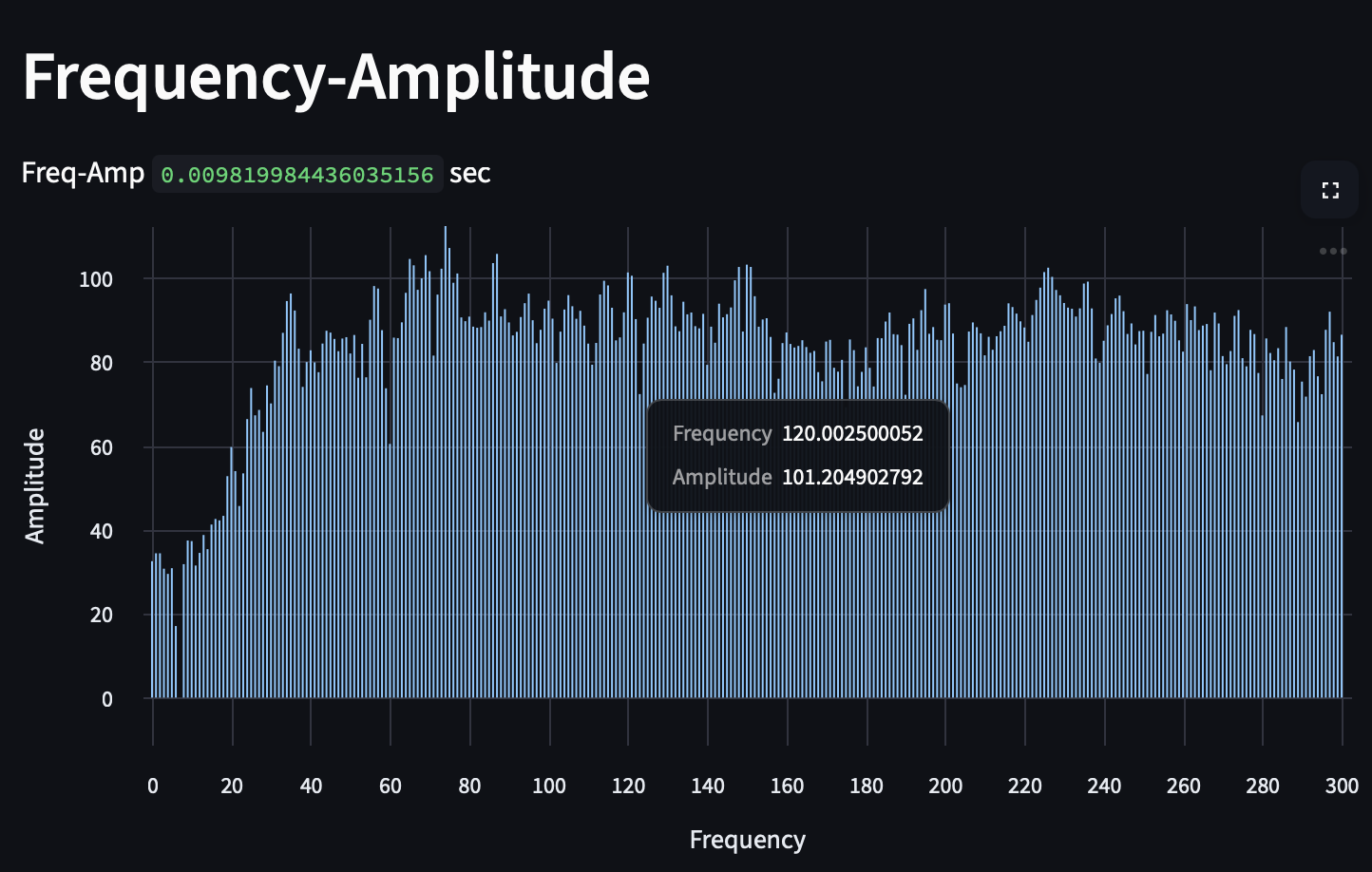
Given that our Fourier transforms have smaller frame sizes, we can make more sense of a longer period of time. The Y-axis is time, the X-axis is frequency, and the color is the relative volume in decibels (relative to the loudest noise). We are able to make out the loud activity of the landscaping equipment and can see every time the spinning blades slow down when they cut through brush.
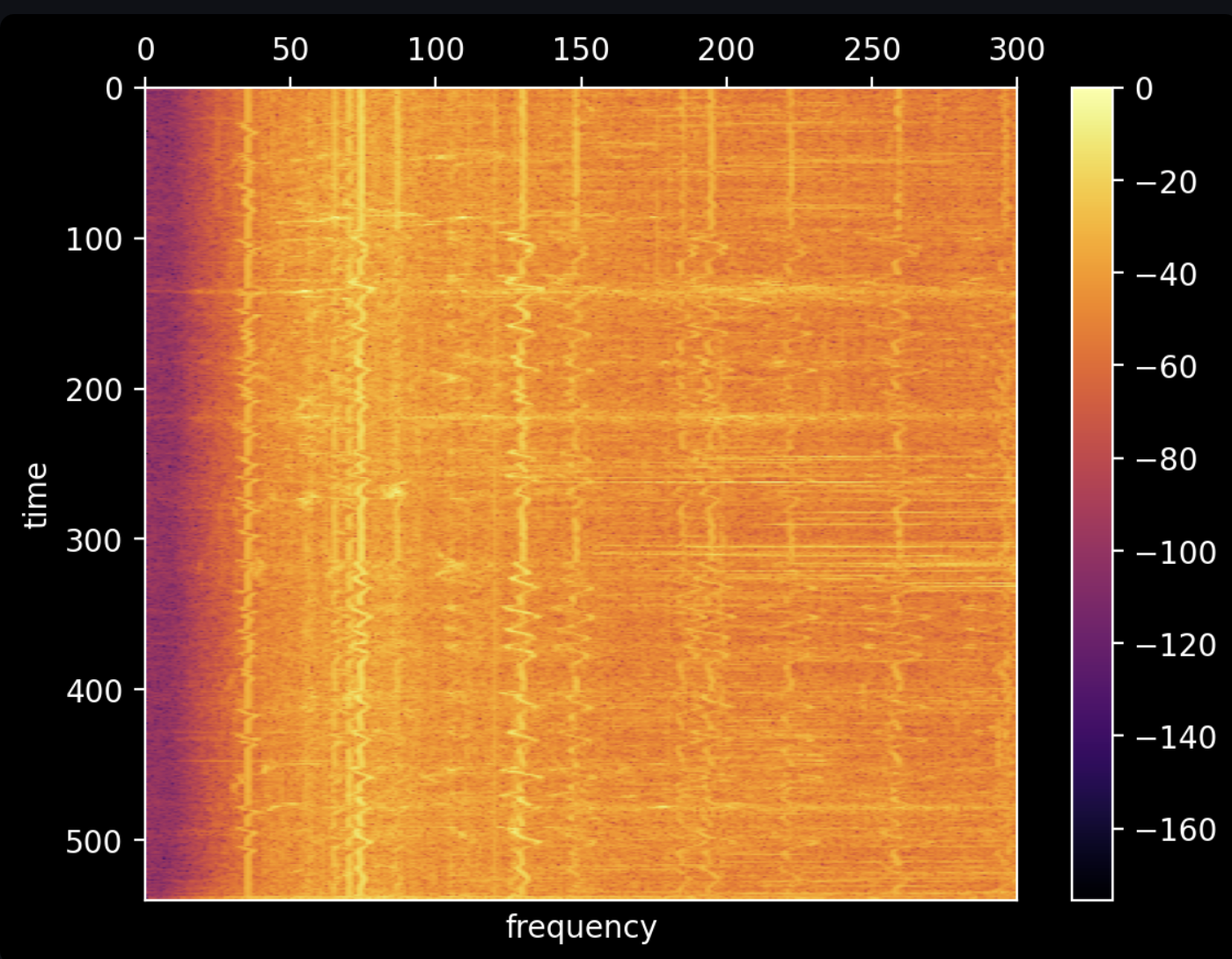
There is a subtle line marking 120 Hz, but it's tough to get anything useful out of it. We can increase the frame size to increase the accuracy and precision of the frequencies in the data. In the below graph, we decrease the frequency of our Fourier transforms to be one every 100 seconds, increasing the frame size to 4,410,000 samples. As you can see below, we sacrifice our ability to detect when something is happening:
| Parameter | Value |
| Sampling Rate | 44.1 kHz |
| Frame Duration | 100 seconds |
| Frequency Step | 0.01 Hz |
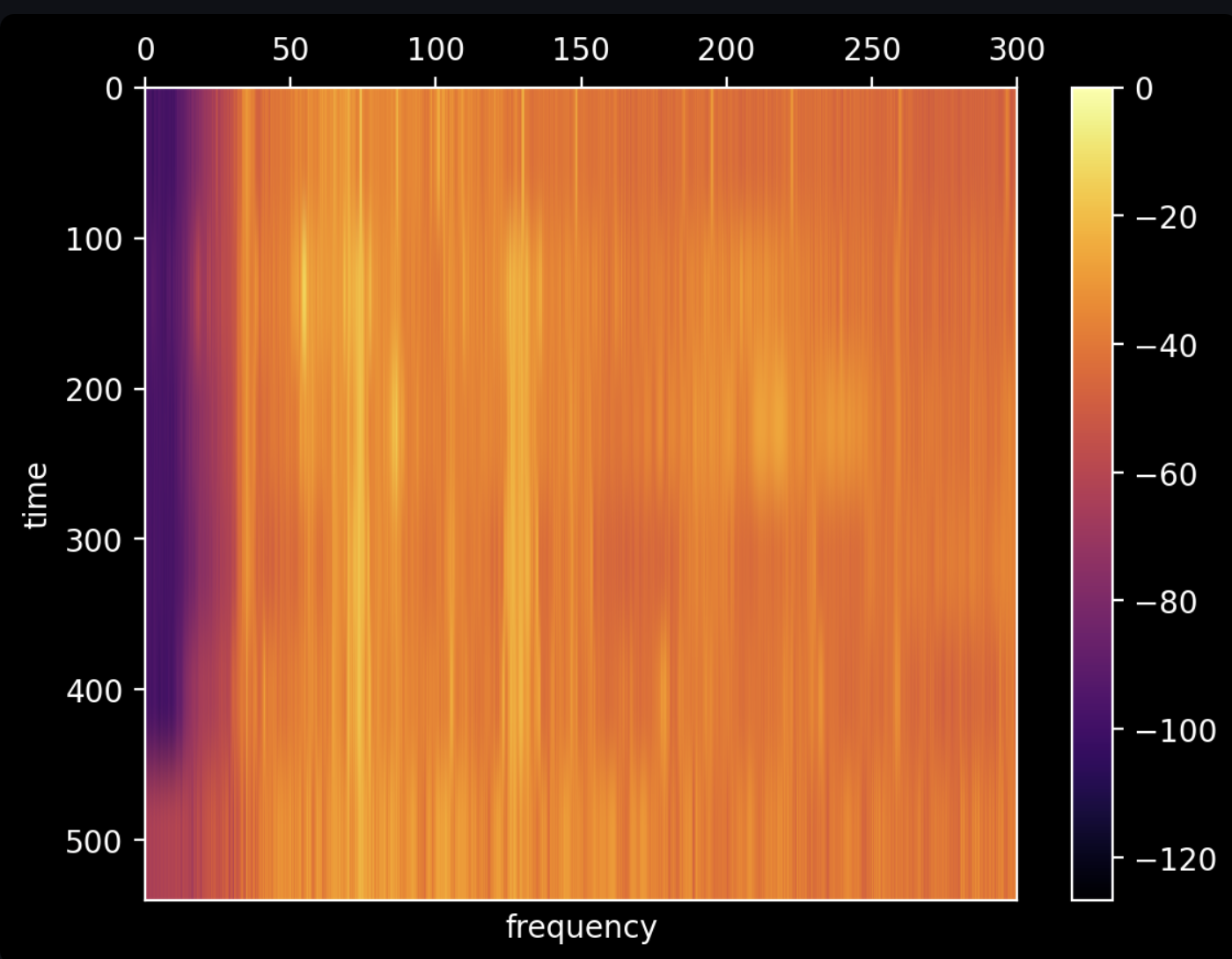
But we gain the ability to see what we're listening to (this is the Fourier transform of the first 100 seconds):
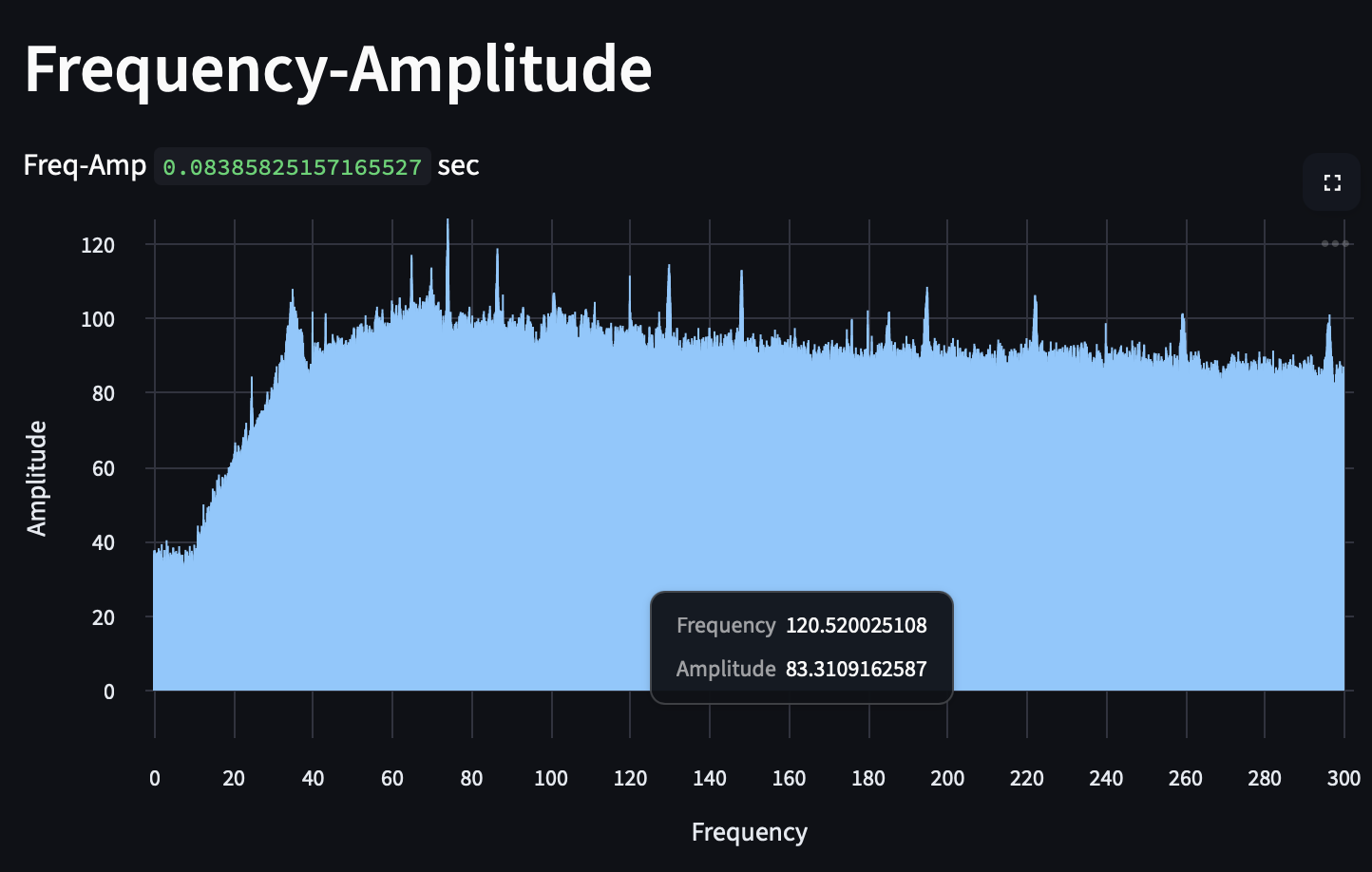
In the above graph, we can see quite clearly that there is a strong 120 Hz tone. The wide peaks mean that the frequency was wavering over the time period of the frame, and the sharp peak of the 120 Hz tone implies stability.
This serves as a single example demonstrating how to effectively extract a signal that is otherwise hidden among the noise, and it is the primary tool for combatting loud environments and interfering noise.
Harmonic Deviation — Harmonics vs Noise
| Parameter | Value |
| Sampling Rate | 44.1 kHz |
| Frame Duration | 100 seconds |
| Frequency Step | 0.01 Hz |
Previously, we looked at the relative strength of a harmonic, asking how many standard deviations above the mean a given frequency was above the mean of its surrounding frequencies. An example distribution of a Virginia substation is below. It was recorded from the grass 20 feet from the fence, which is another 40 feet from the transformers.
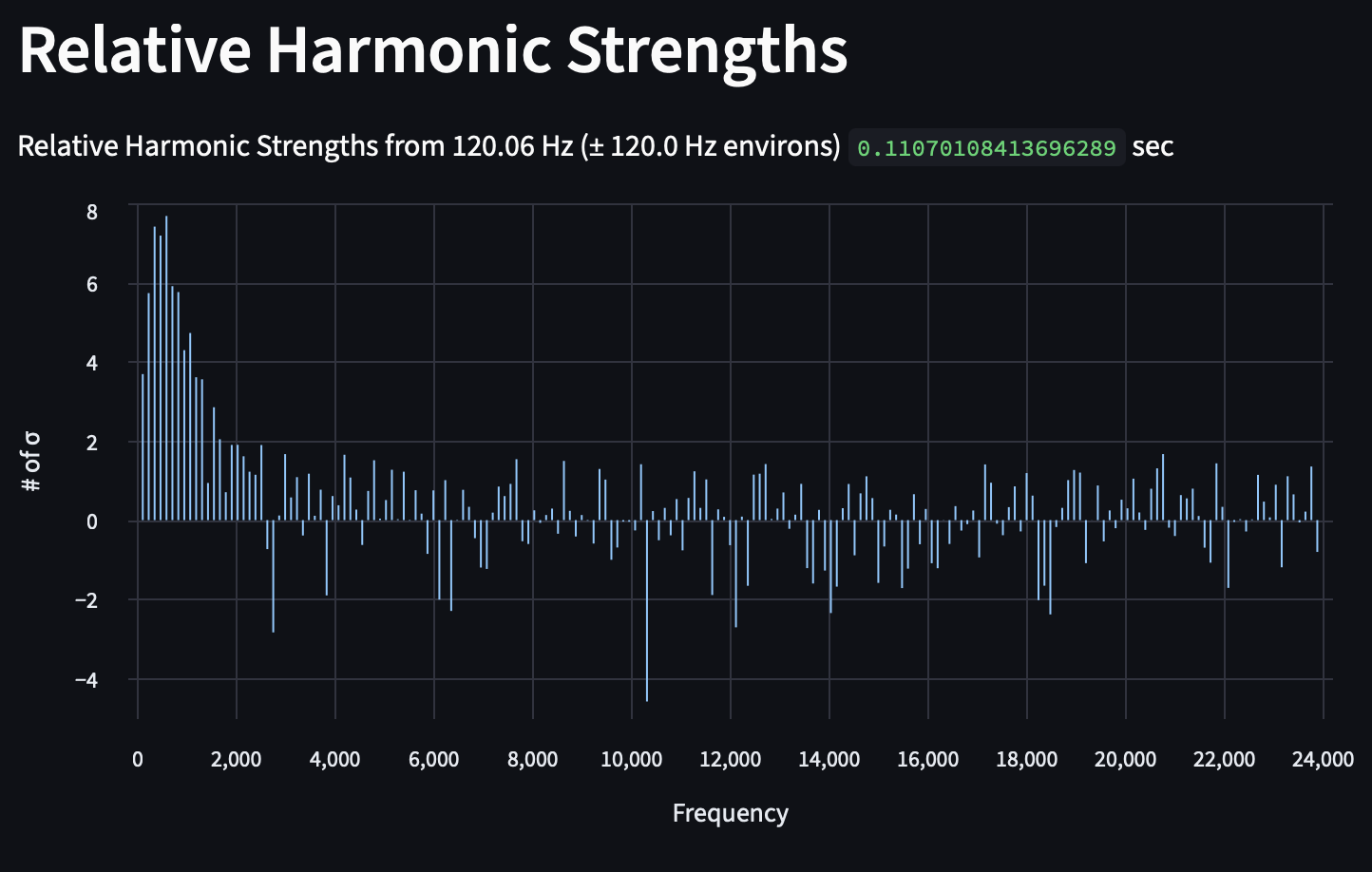
Our next question introduces a new analytical technique, asking whether these frequencies are actual peaks.
- We start with a fundamental frequency that is determined by finding the peak value within a given sideband of 120 Hz.
- We then calculate the harmonics by multiplying the identified fundamental (e.g. 120.02 Hz) by the harmonic number (1, 2, 3, ...). This gives us a "calculated harmonic".
- Then, we observe which frequency is the highest within a sideband (e.g. 0.5 Hz) of the calculated harmonic. This gives us our "actual harmonic".
- We subtract the actual harmonic from the calculated harmonic to get the deviation.
- The results are plotted.
Sideband of 0.25 Hz
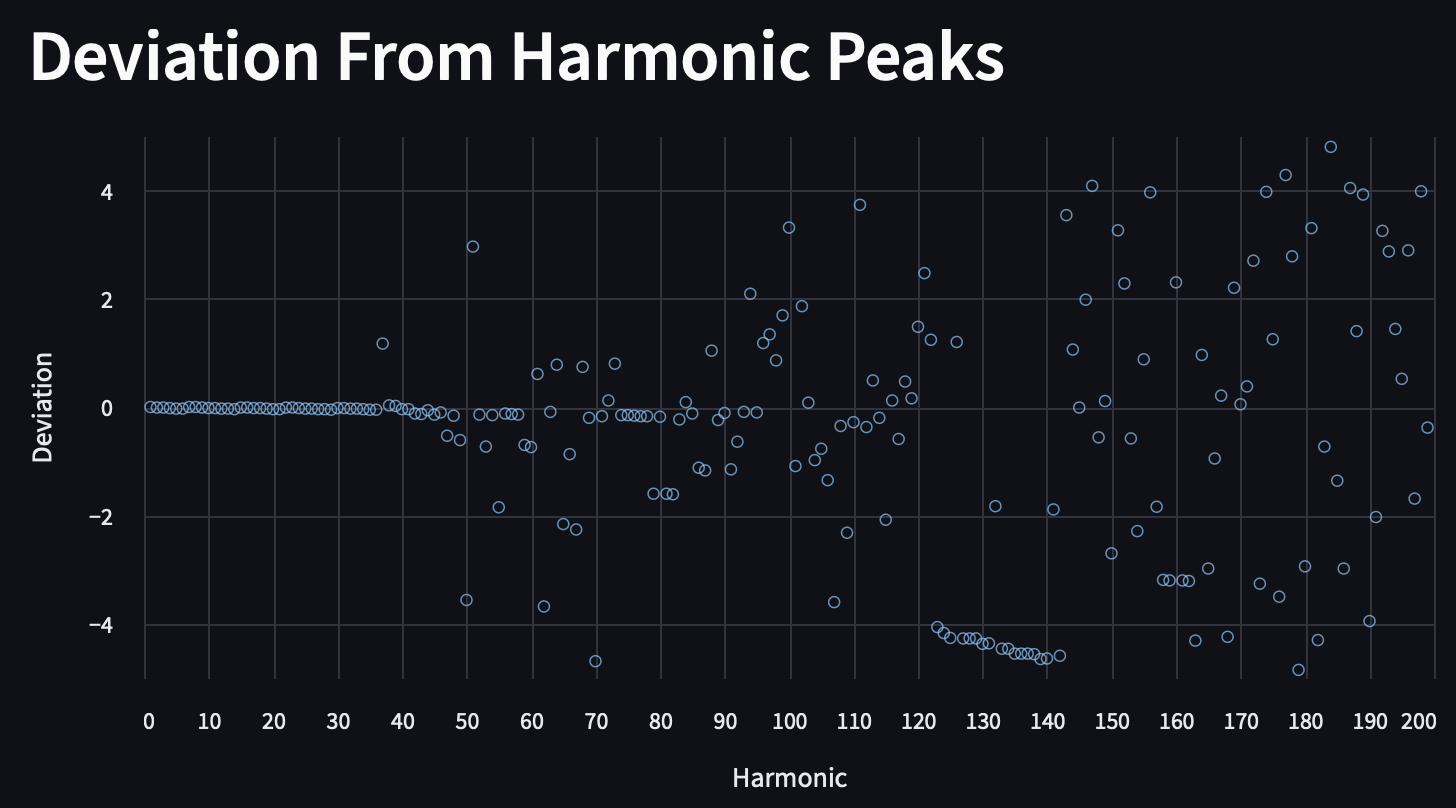
With a sideband of 0.25 Hz, the substation's harmonic deviation starts out very small, but quickly grows after the 10th harmonic, where the deviations are larger but still grouped between -0.1 and 0.1. We can see another dispersal occur after the 35th harmonic, where it becomes truly random.
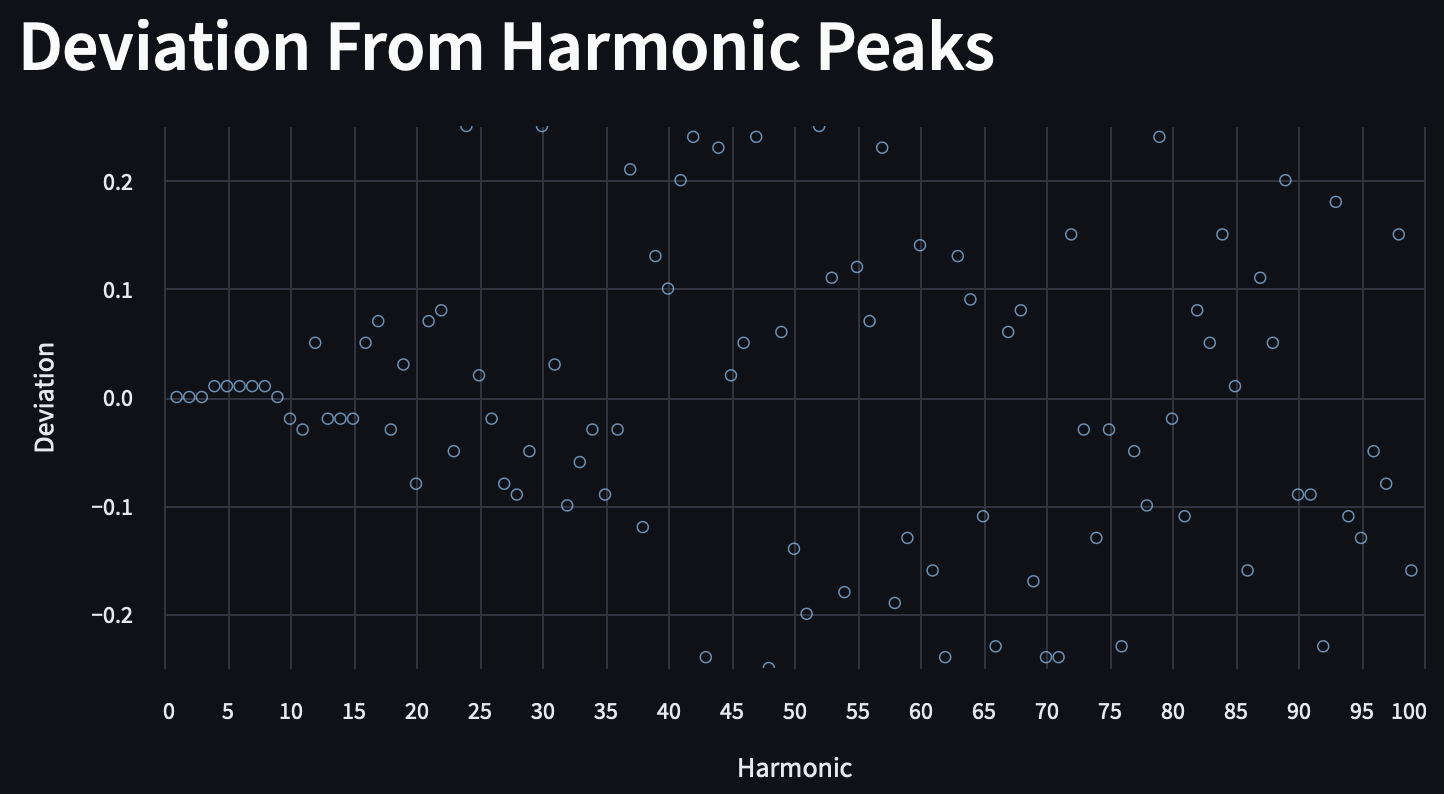
While this may suggest that the calculated peaks are no longer useful beyond the 10th harmonic, we have to consider the unknown margin of error in our instruments; expanding our sideband view offers a different perspective that clarifies reasonable deviation versus random noise. The presence of max and min values (0.25 and -0.25) of deviation here imply that we are stuck in troughs, and that the true peaks of harmonics > 40 lie outside of that restriction.
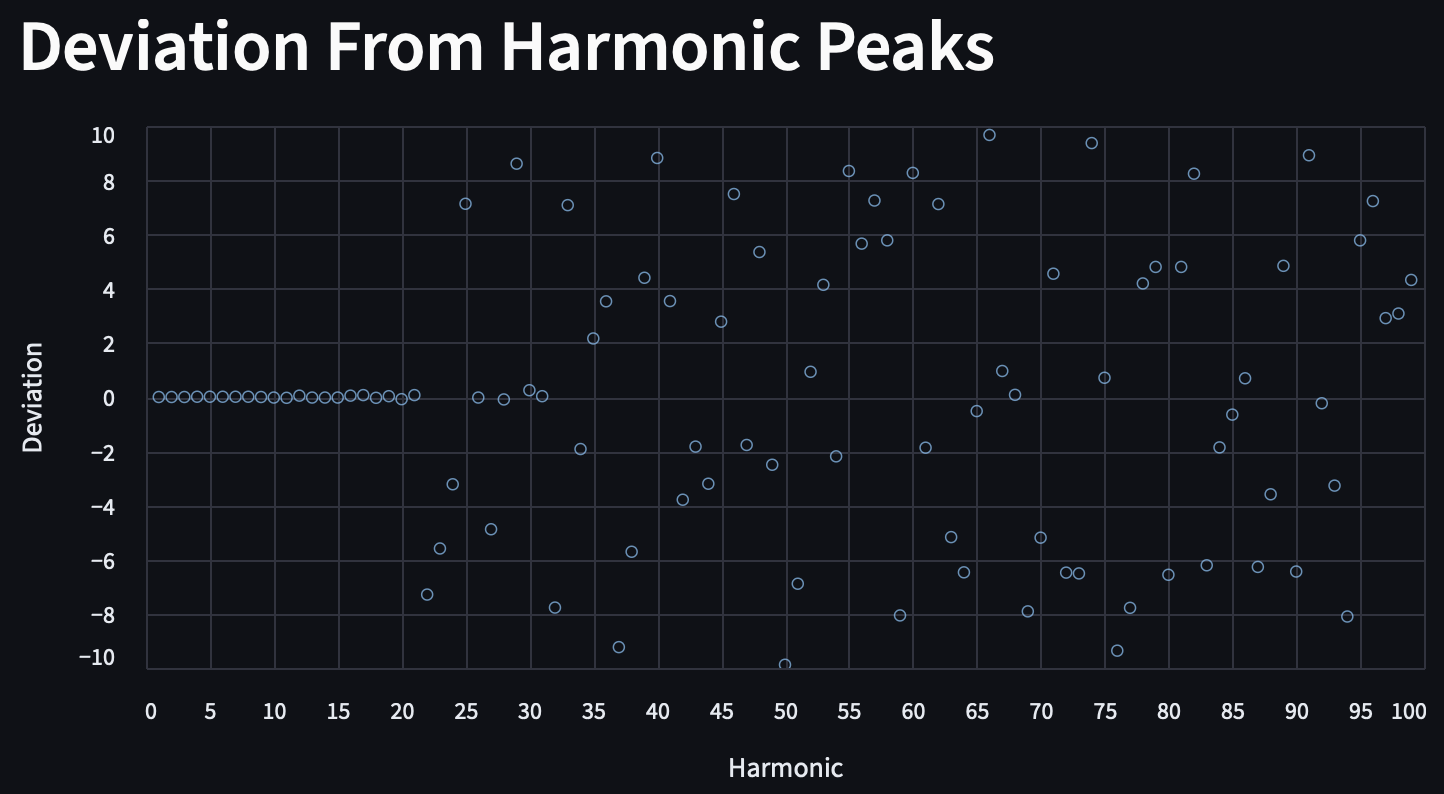
Sideband of 10 Hz
If we allow a 10 Hz sideband to find a peak frequency, we can see more encouraging results, which show strong and consistent harmonics that deviate very little from the calculated harmonics through the 21st harmonic.
Class Evaluation of Harmonic Deviation
Looking at the 26 transformers as a class, we can now measure how deep the harmonics go before beginning to significantly, with a metric known as harmonic depth. Given the relationship between harmonics, distortion, and transformer overloading, we expect this metric to be the primary metric that determines how overloaded a transformer is.
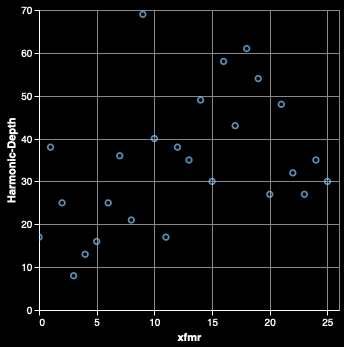
We can see that the harmonic depth of the transformers is evenly distributed across the range, but we have one outlier: transformer #25 with a harmonic depth of 67. This transformer is from Iowa City, IA and is located next a restaurant called the Hamburg Inn.
correlationthedisappearsbelowwhenplotbackgroundofnoiseharmonicgetsdeviationloud(howonmuchhamburgainn,calculatedbutharmonic differs from the actual peak frequency within a 10 Hz band), we can see that there is nearly zero deviation up until the 40th harmonic. Then, some noise is introduced that obscures the transformer harmonics. Between the 59th and 73rd harmonic, there is too much noise to identify any real harmonic, although given that the deviation is generally closer to 0 than beyond the 150th harmonic (where itcomebecomesbacktrulyaroundrandom),75thwe-believe80ththat there is still some latent correlation. At the 74th harmonic, the intervening noise dissipates, and we are able to precisely identify the harmonic again.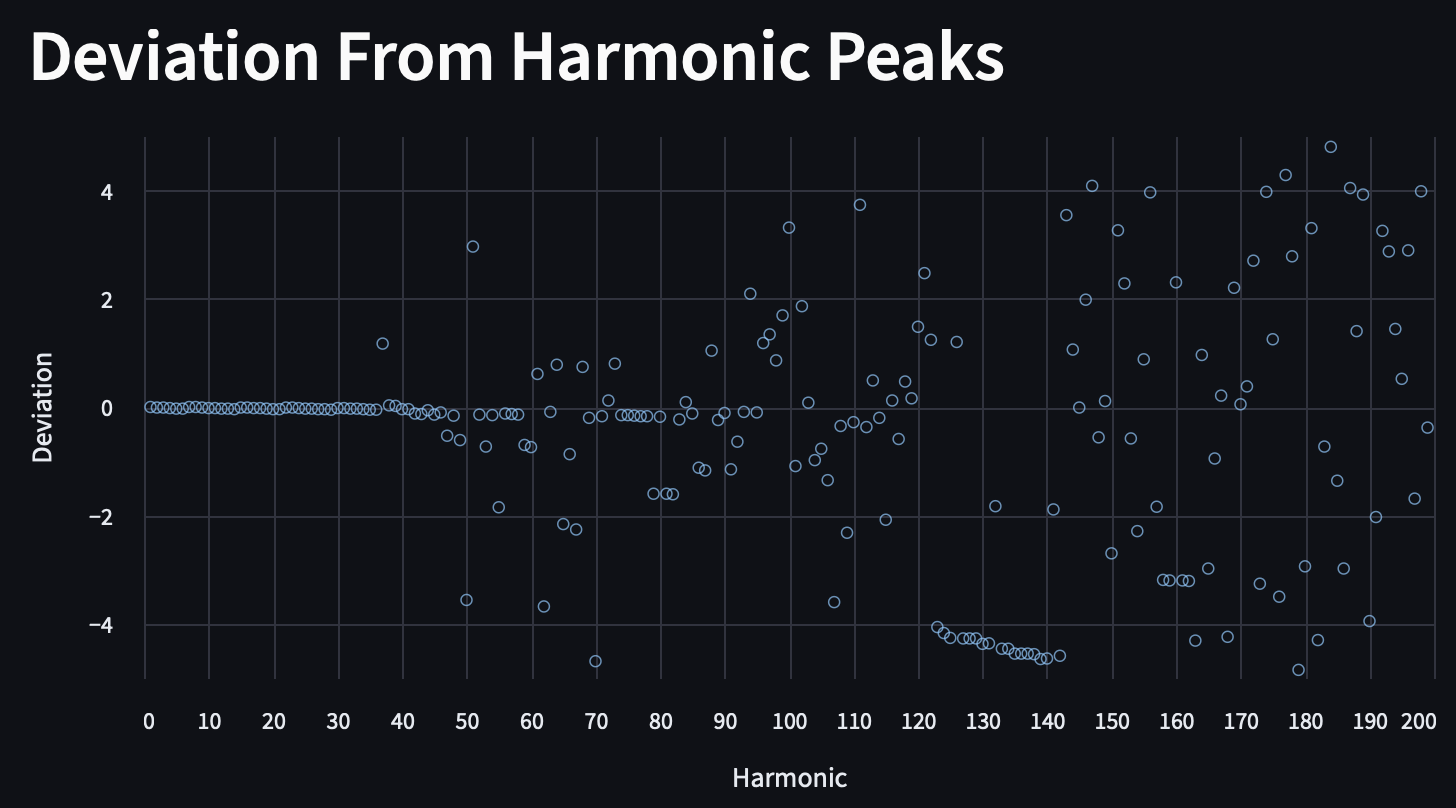
When conducting any kind of further analysis on the harmonics, we take care to only use the harmonics
- that
maybearetalkwithinabout0.5backgroundHz deviation, so that noise is not included.Harmonic Sequences
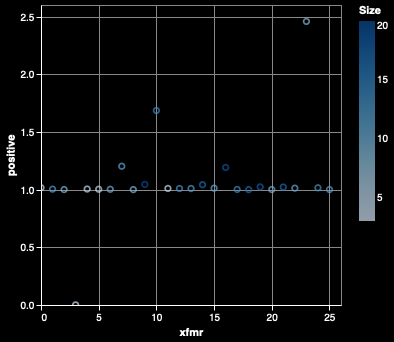
Harmonic sequences are defined as the positive, negative, and
gettingzeroridharmonics, which correspond to those whose harmonic modulo 3 is 1, 2, and 0, respectively.For a total of
it$m$
harmonics - (whose deviation is less than 0.5 Hz from the detected nearby peak), the value is calculated as:
$\Sigma^m_n Amplitude_n^2$
Positive Harmonics
Harmonic Parity
asdf
Unusual
thingsFindingscrazy strong fundamentalStrong 120 Hz
inFundamentalRestonasdf
office park #1crazy weak fundamentalWeak 120 Hz
inFundamentalNewasdf
PioneerHalf
foodHarmonicscoophalf harmonics
harmonicssequencesparity
In

asdf