
Transformer tank vibration modeling as a method of detecting winding deformations — Part I: Theoretical foundation (2006)
Abstract
In this paper, a model developed for a transformer monitoring system to estimate transformer tank vibration is presented. The model calculates vibration on the transformer tank starting from some input variables that can be easily measured on the transformer. Tank vibration is also measured, showing a good concordance between estimated and measured values if the transformer is healthy. In case of a winding deformation winding vibration and, consequently, that of the tank, changes and a big difference between estimated and measured vibration appear. To estimate tank vibration, the model takes into account the main physical phenomena generating vibrations in the different transformer elements and how these vibrations are superposed and transmitted to the tank. The model has been tested experimentally on a test transformer fitted with internal and external accelerometers. A deformation has been provoked in the test transformer winding with the aim of testing the model’s ability to detect it. The model has been also tested on several in-service grid transformers. The results of the experimental validation are shown in Part II of the paper.
Introduction
- 12-15% of transformer failures are caused by winding deformations
- provoked by high electrodynamic forces caused during a short-circuit event
- I wonder if GridScan can detect this
- this paper is old, Cigré says it's 45% now
- provoked by high electrodynamic forces caused during a short-circuit event
Vibration Model
- winding vibrations
- electrodynamic forces caused by the interaction of the current in the winding with leakage flux
- core vibrations
- magnetostriction
- magnetic forces
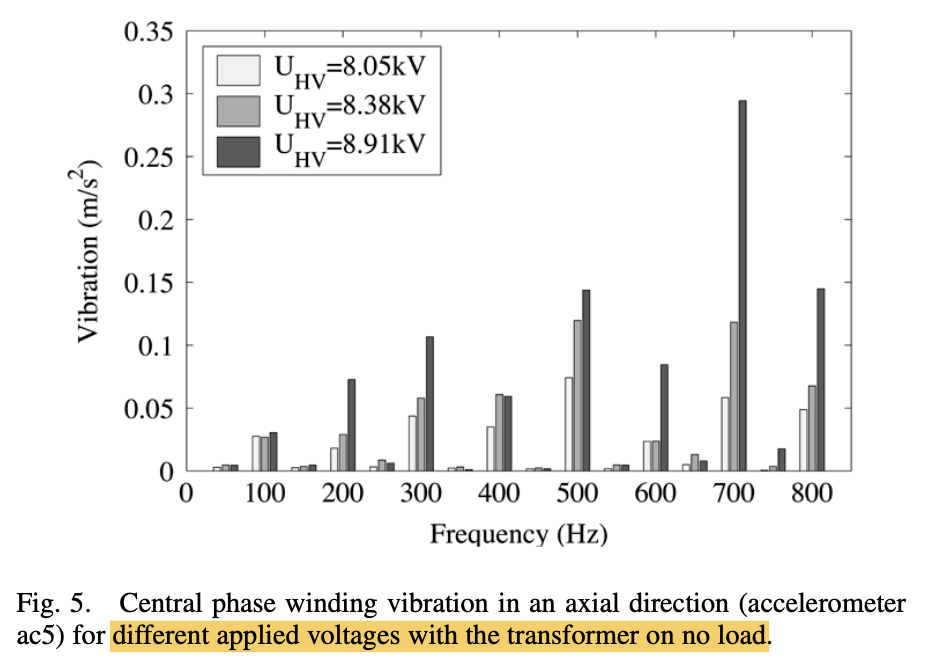
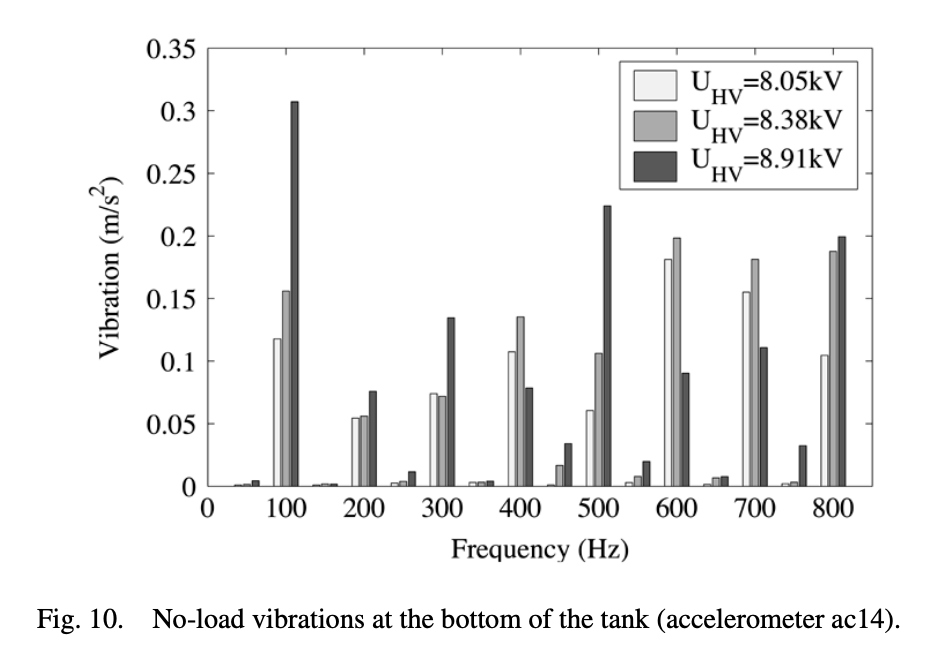
- magnetostriction is proportional to voltage squared
- dependent upon temperature
- load tap changer (LTC) vibrations might be >1 kHz
Vibrational Experimental Analysis
Conclusion
- no real way to discern core noise from winding noise
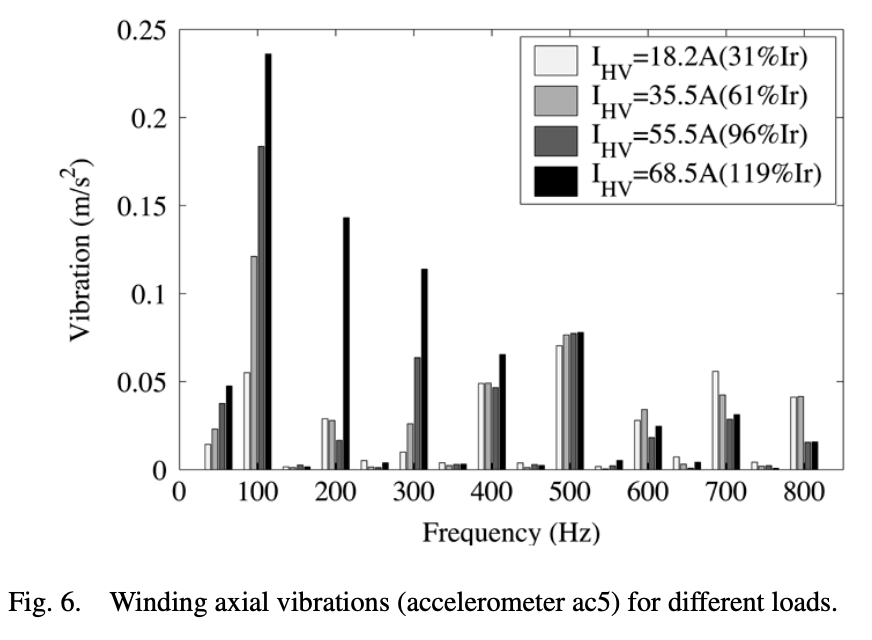
- overloading is going to be BAD for 2nd and 3rd harmonics
- why? I thought rated loading was an artificial limit vs physical
- appears not!
- why? I thought rated loading was an artificial limit vs physical
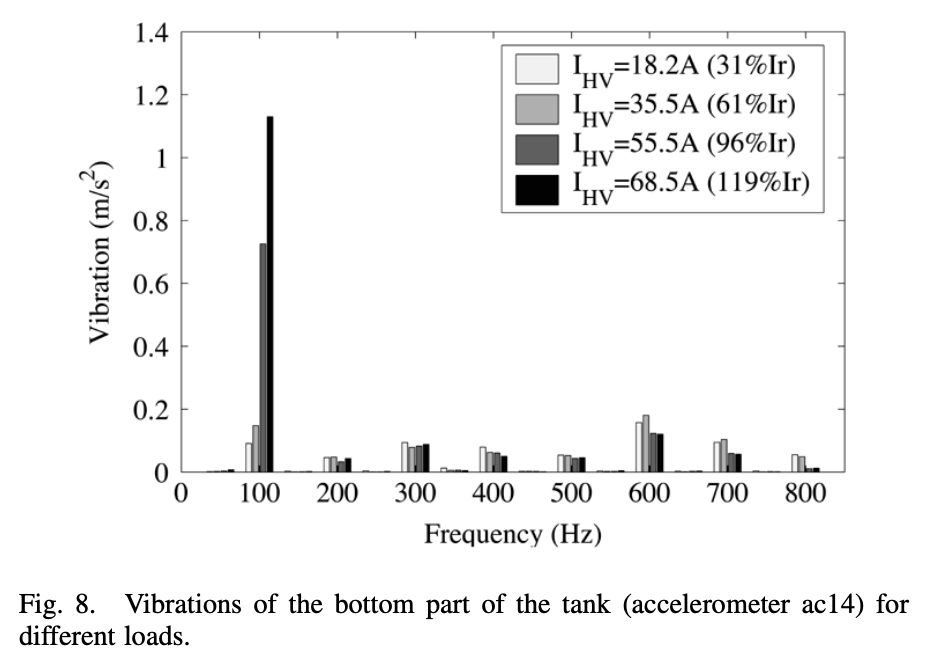
- 50 Hz is proportional to loading
- I'm still pretty sure this is just the
- 1st, 5th, and maybe 8th are good for current/loading
- 2nd, 3rd, 7th, 8th are good for voltage
- especially 7th